


Every day, the average person makes over 35,000 decisions. Yet research from Columbia Business School shows that decision fatigue alone costs organizations billions in lost productivity each year. The good news is that mental models for decision making give you a smarter, faster, and more reliable way to think through any situation. These frameworks act as cognitive shortcuts built from decades of scientific, psychological, and business insight. In this guide, you will discover the most powerful models, how they work, and exactly how to apply them in your daily life.
What Are Mental Models and Why Do They Matter?
A mental model is a simplified representation of how something works in the real world. Think of it as a thinking lens that helps you filter information, spot patterns, and choose better actions. Without these frameworks, most people rely on gut feeling alone, which often leads to costly mistakes.
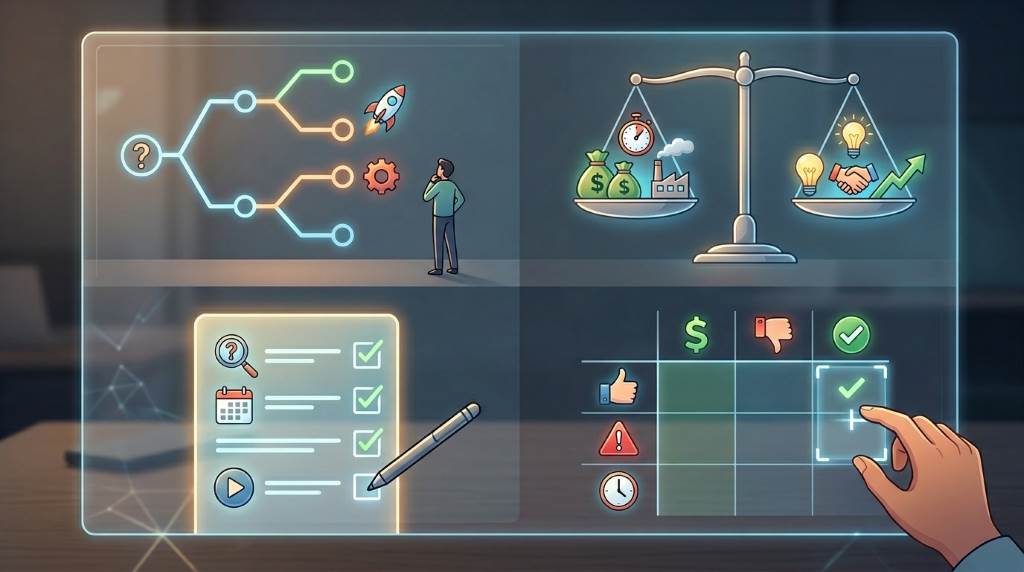
Mental models for decision making matter because they reduce cognitive bias and increase the quality of your choices. They help you ask better questions before committing to a path. Leaders, investors, and scientists have used these frameworks for centuries to gain a consistent edge. Charlie Munger, the legendary investor, famously built a “latticework of mental models” to guide every major financial decision he made.
Using the right model does not mean overthinking every choice. Instead, it means equipping your brain with reliable tools so that complex problems feel manageable. Furthermore, these frameworks help you communicate your reasoning clearly to others. When your decisions are grounded in structured thinking, trust and credibility follow naturally.
The First Principles Thinking Model
First principles thinking is one of the most powerful mental models for decision making available today. It means breaking a problem down to its most fundamental truths and reasoning up from there. Elon Musk famously used this approach to dramatically reduce the cost of rocket manufacturing at SpaceX.
Most people reason by analogy, meaning they copy what has worked before. First principles thinkers, however, ask “what is actually true here?” before building a solution from scratch. This approach challenges assumptions that everyone else has accepted without question. As a result, it often produces solutions that are both surprising and highly effective.
To apply this model, start by identifying the problem you want to solve. Then list every assumption behind your current approach and ask whether each one is actually true. Strip away the borrowed logic and rebuild your thinking on verified facts. Consequently, you will often find cheaper, faster, or more creative solutions hiding just beneath the surface.
The Inversion Model: Think Backward to Move Forward
Inversion is a mental model that asks you to flip the problem upside down. Instead of asking “how do I succeed?” you ask “what would guarantee failure?” This simple shift in perspective reveals hidden risks and obstacles that forward thinking often misses.
The German mathematician Carl Jacobi popularized the phrase “invert, always invert” as a core problem-solving tool. Investors use inversion to stress-test portfolios by imagining worst-case scenarios first. Engineers use it to build safer systems by designing around known failure points. Therefore, inversion is not pessimistic; it is strategically protective.
- Ask: What are all the ways this decision could go wrong?
- List every assumption that, if false, would derail your plan.
- Work backwards from a failed outcome to identify the cause.
- Then remove or reduce those failure conditions proactively.
Applying inversion consistently will make your planning more robust and your decisions more resilient. It is a particularly valuable mental model when stakes are high and reversing course would be costly. Moreover, it builds intellectual humility because it forces you to confront your blind spots directly.
The Second-Order Thinking Model
Second-order thinking means considering not just the immediate outcome of a decision, but also the downstream consequences that follow. Most people stop at first-order effects, asking only “what happens next?” Second-order thinkers go further and ask “and then what?”
Howard Marks, the billionaire investor, writes extensively about second-order thinking as the defining trait of superior decision makers. When a government lowers interest rates, the first-order effect is cheaper borrowing. The second-order effect might be asset price inflation, which can create financial bubbles years later. Seeing these ripple effects in advance is a genuine competitive advantage.
You can practice this model by mapping out decisions on paper. Write down your choice, then list its likely first-order outcomes. Next, examine each of those outcomes and list what comes after. This exercise quickly reveals whether a seemingly good decision has hidden long-term costs. Additionally, it trains your brain to naturally think in systems rather than isolated events.
Second-order thinking also improves your relationships and communication. When you understand how your words or actions ripple outward, you become a more thoughtful leader and collaborator. Over time, this mental model builds the kind of strategic foresight that distinguishes great thinkers from average ones.
The Opportunity Cost Model
Every decision you make comes with a hidden price: the value of the next best alternative you gave up. This is the core insight of the opportunity cost mental model. Economists have studied this concept for over a century, yet most people ignore it completely in daily life.
Opportunity cost thinking is particularly powerful in time and resource allocation. When you say yes to one project, you are implicitly saying no to every other project competing for that same time. Therefore, the real question is never “is this a good use of my time?” but rather “is this the best use of my time right now?” That small shift in framing changes everything.
- Before committing, list your top three alternatives.
- Estimate the value you would get from each option.
- Choose only when the selected option clearly outperforms the rest.
- Revisit this regularly as circumstances and options change.
Applying opportunity cost thinking prevents you from clinging to mediocre choices out of habit or comfort. It also reduces the sunk cost fallacy, where people continue investing in a failing path simply because they already invested in it. Consequently, your decisions become more dynamic, flexible, and aligned with your actual goals.
The Confirmation Bias Antidote: The Steel Man Model
Confirmation bias is one of the most dangerous cognitive traps in decision making. It causes people to seek out information that supports what they already believe and ignore evidence that challenges it. The steel man model is a direct antidote to this bias.
Unlike the straw man, where you misrepresent an opposing view to defeat it easily, the steel man asks you to build the strongest possible version of the opposing argument. This forces genuine engagement with alternative perspectives. As a result, your decisions are tested against the best available counterarguments, not the weakest ones.
To use this model, first state your own position clearly. Then spend equal time constructing the most compelling case for the opposing view. Ask yourself honestly whether that counterargument changes or complicates your original position. Finally, proceed with your decision only after genuinely wrestling with that tension.
This mental model is especially valuable in high-stakes scenarios such as business strategy, hiring decisions, or policy planning. Furthermore, it improves your relationships by making others feel truly heard rather than dismissed. Leaders who practice steel manning consistently earn deeper respect and make more defensible decisions.
The Map vs. Territory Model
The philosopher Alfred Korzybski wrote that “the map is not the territory,” meaning that our mental representations of reality are always incomplete. This mental model reminds decision makers that every plan, framework, or strategy is only an approximation of the real world. Treating your model as perfect reality is a recipe for costly surprises.
In practice, this means you should always question the assumptions baked into your plans. A budget projection is a map, not the actual future. A business strategy is a map, not a guarantee. Successful decision makers continuously update their maps as new information arrives from the real territory. Therefore, intellectual humility and adaptability are as important as analytical skill.
This model also helps prevent overconfidence. When you know your map is incomplete, you build in contingency plans and remain open to course correction. Consequently, your decisions become more durable under real-world conditions. Additionally, communicating this principle to your team builds a culture of honest feedback rather than false certainty.
Building Your Personal Decision-Making Framework
Now that you understand the core mental models for decision making, the next step is building a personal system that uses them consistently. No single model works perfectly for every situation. Instead, the most effective thinkers maintain a toolkit of multiple frameworks and choose the right one based on context.
Start by identifying the type of decision you face. Is it reversible or irreversible? Is it time-sensitive or open-ended? Does it involve high uncertainty or relatively known variables? Your answers should guide which model you reach for first. For example, inversion works best for high-stakes irreversible choices, while opportunity cost thinking shines in resource allocation scenarios.
- Write your decision and its context at the top of a page.
- Apply at least two different mental models to the same problem.
- Note where the models agree and where they diverge.
- Use the points of divergence as areas for deeper research.
Journaling your decisions and reviewing outcomes over time is one of the most powerful accelerators of decision-making skill. Moreover, sharing your reasoning with a trusted advisor invites feedback that refines your mental models further. Over months and years, this deliberate practice compounds into genuine wisdom.
Conclusion: Start Applying Mental Models for Decision Making Today
Mental models for decision making are not abstract theory. They are practical, proven thinking tools that anyone can learn and apply starting today. From first principles to inversion to second-order thinking, each framework gives you a new angle on every problem you face. Together, they form a cognitive system that consistently outperforms gut-feeling decision making.
The most important step is to start small. Pick one model from this article and apply it to the next meaningful decision you face. Notice how it changes your thinking and the quality of your outcome. Then gradually expand your toolkit until multi-perspective reasoning becomes your natural default.
Your challenge: The next time you face a major decision, write it down and run it through at least two mental models before acting. Share your experience with a colleague, mentor, or team member. Better decisions lead to better outcomes, and better outcomes lead to a better life. Start building your latticework of mental models today.
Frequently Asked Questions
What are mental models for decision making?
Mental models are thinking frameworks that simplify complex problems and help you make faster, more reliable decisions by structuring how you analyze information.
Which mental model is best for everyday decisions?
Opportunity cost thinking and second-order thinking are highly practical for daily use because they help you evaluate trade-offs and downstream consequences quickly.
How long does it take to learn mental models?
You can begin applying basic mental models within days, but mastery through consistent practice and reflection typically develops over several months to years.
Are mental models the same as cognitive biases?
No, mental models are deliberate thinking tools you use proactively, while cognitive biases are automatic mental errors that distort your thinking without you realizing it.
Can mental models improve team decision making?
Yes, when teams share a common set of mental models, they communicate more clearly, debate more productively, and reach stronger collective decisions faster.

Leave a Reply