


Studying effectively means using methods that match how your brain stores and recalls information. It’s not about rereading notes for hours. The fastest way to remember more is to combine active recall, spaced repetition, and smart scheduling. Once you make this shift, exam prep stops feeling like a stressful marathon. It starts to feel like a system you can trust.
Most young adults never learned how to study. School teaches content. It rarely teaches the mechanics of memory. That’s why so many students highlight textbooks for hours and still blank out during the test. Highlighting feels productive, but it doesn’t build real recall.
This guide breaks down specific, research-backed methods. Use them to study smarter, retain more, and walk into your exam with real confidence instead of last-minute panic.
Why Rereading and Highlighting Don’t Work
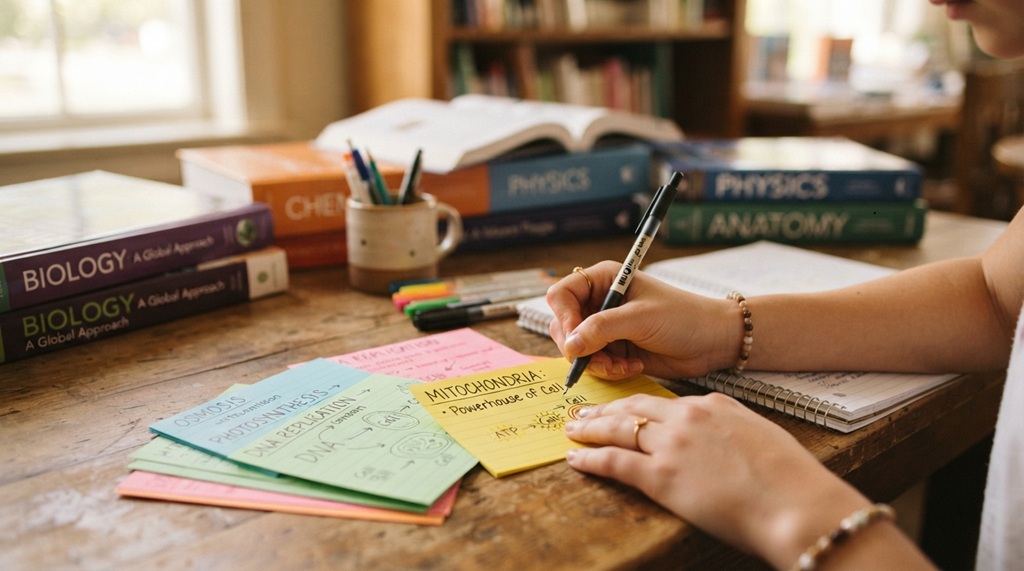
Rereading and highlighting create a false sense of familiarity, not real memory. When you reread a paragraph, your brain recognizes the words. That recognition feels like knowledge. But recognizing information is not the same as retrieving it without help.
Experts call this the “fluency illusion.” The material feels easy while you’re looking at it, so your brain assumes it has learned the content. Then, during the exam, there’s no textbook to jog your memory. The information just isn’t there. Learning science experts note that techniques which force you to retrieve information rather than simply review it build far stronger long-term retention.
The fix isn’t to study longer with the same methods. Swap passive review for techniques that make your brain work to pull information out.
Use Active Recall Instead of Passive Review
Active recall means testing yourself on material instead of just looking at it again. Research consistently ranks it as one of the most effective study techniques available.
How to Practice Active Recall
- Close your notes. Write down everything you remember about a topic, then check what you missed.
- Turn headings and subheadings into questions. Answer them without looking.
- Use flashcards the right way: produce the answer before you flip the card. Don’t just read both sides in a row.
- Explain the concept out loud, as if you’re teaching someone who’s never heard of it. People call this the “Feynman Technique.”
Why This Beats Rereading
Every time you struggle to retrieve information and succeed, that memory pathway gets stronger. Researchers call this “desirable difficulty.” It feels uncomfortable in the moment, which is exactly why most students avoid it. But that discomfort signals real learning.
Space Out Your Study Sessions Instead of Cramming
Spacing your sessions across several days builds much better retention than cramming the night before. Your brain needs repeated exposure over time to move information into long-term memory.
Cramming can help you recognize information for a day or two. It rarely survives past the exam itself. Researchers call this pattern the forgetting curve. It shows that we lose a large share of new information within the first 24 hours unless we review it again.
A Simple Spacing Schedule You Can Use
- Day 1: Learn the material. Do a quick active recall check.
- Day 2 or 3: Review it again without looking at your notes first.
- One week later: Test yourself again briefly.
- A few days before the exam: Do a final full review. Focus on your weak spots.
This schedule doesn’t take more total study time than cramming. It just spreads that time out, and that’s what makes the memory stick.
Break Study Sessions Into Focused Blocks
Short, focused study blocks with real breaks build better concentration than long, uninterrupted marathons. Your attention naturally dips after 25–50 minutes of focused work. Push past that point, and you’re technically studying, but you’re not absorbing much.
How to Structure Your Study Blocks
- Study in focused intervals of 25–50 minutes. Then take a real 5–10 minute break away from your phone.
- Use each block for one specific topic or task. Skip vague sessions like “study biology.”
- After 3–4 blocks, take a longer 20–30 minute break to actually reset.
- Protect your breaks. Scrolling social media doesn’t let your brain rest the way a short walk or stretch does.
This structure also makes studying feel less overwhelming. You commit to one short block at a time, not an open-ended, dreaded session.
Sleep, Movement, and Nutrition Matter More Than You Think
Your brain consolidates memory largely during sleep. That’s why pulling an all-nighter before an exam can undo hours of studying you already did.
Most students overlook this part of exam prep. They spend hours perfecting their notes, then sacrifice sleep the night before. But sleep is the step where learning actually locks in.
Practical Habits That Support Memory
- Prioritize sleep the whole week of your exam, not just the night before. Consistent sleep across several nights matters more than one “good” night.
- Move your body between study sessions. Even a short walk can improve focus and mood, and that supports better studying.
- Stay hydrated and eat regular meals. Skipping meals to “save time” often backfires, because low energy makes it harder to concentrate and recall information.
- Limit caffeine late in the day. It can interfere with the sleep your brain needs to consolidate memory.
Teach the Material to Someone Else (Or Pretend To)

Teaching a concept forces you to organize it clearly enough that someone else could follow it. This exposes gaps in your understanding faster than almost any other method.
Students underuse this technique because it feels less “efficient” than passively reviewing notes. But try to explain a concept simply, out loud, in your own words, without jargon. You’ll immediately notice which parts you truly understand and which parts you just recognize.
How to Use This Even Without a Study Partner
- Explain the topic out loud to an empty room, a pet, or your phone’s voice recorder.
- Write a short “explain it to a beginner” summary for each major topic.
- Study with a friend. Take turns playing the “student” who asks confused questions.
- If something is hard to explain simply, that’s the exact topic you need to review again.
Strategic Planning: Eliminate Procrastination and Accelerate Recall
Building an effective study plan is less about logging endless hours and more about removing cognitive friction—breaking overwhelming material into precise, actionable tasks assigned to specific dates. Broad, ambiguous targets like “study for finals” trigger decision fatigue and invite procrastination because your brain lacks a clear point of entry. Specific, scheduled milestones eliminate that hesitancy, creating structured momentum that dramatically reduces last-minute exam stress. Ultimately, mastering exam preparation extends beyond rote memorization; it requires cultivating dynamic cognitive habits that train your brain to digest and retain complex concepts effortlessly. If you want to expand these techniques beyond test preparation and rapidly master any discipline, learn a new skill fast: 7 proven methods.
Steps to Build a Realistic Study Plan
- List every topic or chapter that could be on the exam.
- Estimate how many sessions each topic needs. Be honest about which ones are harder for you.
- Work backward from the exam date. Space sessions out instead of stacking them all at the end.
- Schedule review days, not just new-material days, so earlier topics don’t fade.
- Build in buffer days. The topics that take longer than expected always show up.
A realistic plan on paper beats a perfect plan you abandon after two days. Keep it simple enough that you’ll actually follow it.
Frequently Asked Questions
How many days before an exam should I start studying?
Start at least 1–2 weeks ahead. That gives you enough time to space out review sessions instead of cramming. Harder or content-heavy subjects may need even more lead time.
What’s the single most effective study technique?
Active recall wins here. Testing yourself on material instead of rereading it strengthens the exact retrieval process you’ll need during the exam. Pair it with spaced repetition for the strongest results.
Is it better to study alone or in a group?
Both can work, depending on your goal. Studying alone often suits active recall and focused review best. Group study helps you explain concepts to each other and catch gaps you missed on your own.
How do I stop procrastinating on studying?
Break your studying into small, specific tasks, like “review 10 flashcards on Chapter 3.” Skip vague goals like “study for the exam.” Start with just one short, focused block. That’s usually enough to break the initial resistance.
Does music help or hurt while studying?
It depends on the task and the person. Lyric-heavy music can interfere with reading and writing tasks. Instrumental or ambient sound works well for some people and not others. Test what actually helps your focus instead of assuming.
Conclusion
Studying effectively isn’t about the number of hours you put in. It’s about using techniques that build real memory: active recall, spaced repetition, focused study blocks, and enough sleep for your brain to consolidate what you’ve learned. Small changes make the biggest difference test yourself instead of rereading, and spread sessions across days instead of cramming.
Start with just one technique from this guide. Active recall or session spacing are the easiest places to begin. Build from there. Consistent, smart studying beats last-minute panic every time, and now you have a system to make that happen.

Leave a Reply